Wednesday, January 22, 2014

Ponniyin Selvan novel characters.


Vallavarayan Vanthiyathevan was a real personality who existed in Chola regime under Rajaraja and before. His origins and clan are subjects of great debate. Sadasiva Pandarathar suggests that he might have belonged to eastern chalukya but without offering much evidence to support his claim. From evidences gathered so far he is a Rashtrakuta king and absolutely nothing to prove his connectivity with Vaanar Kulam. We don’t know why Kalki strongly believed his clan is Vaanar Kulam.

To add more evidence that he is a Chalukyan if you look at chola dynasty since Adithya Chola it has been a trend to strengthen their ties through marital alliances. Right from Adithya, Paranthaga and Sundara we see kings marrying many daughters, sometimes from potential would-be enemy empires and forge solid relationship with them. And in case of Vanthiyathevan, we see that he married Kundavai, perhaps the most powerful princess of her times. It’s worthwhile to ponder whether this had any gains to chola empire. In this light, it makes sense to view Vanthiyathevan as a east chalukyan prince, because later we see Rajaraja forging very strong relationship with them by giving his daughter to Vimaladitya, who is of chalukyan origin. (This resulted in a completely different set of chola-chalukya clan, from the time of Kulothungan I). It is evident that Rajaraja would not have experimented this marriage unless he had a strong faith in their relationship. This could have been due to Vanthiyathevan.

Coming to the Vanthiyathevan character which Kalki created, the first thing that should be held in mind is that, initially he was not intended to be a hero Kalki wanted to sideline him, just like Paranjyothi of Sivakamiyin Sabatham, after making use of him to introduce the characters and places. But it so happened that the character grew steadily on his own might, and in spite of the elaborate introductions, Arumozhi failed to capture the hearts of people as much as Vanthiyathevan did. In fact, in certain portions where Vanthiyathevan is not featured for several chapters, his absence can be noticed so vividly that during his reappearance Kalki will write, “We have deserted our hero for a long time…” This is the first occasion in which Kalki recognizes him as the true hero of this story. This is a typical example for the case in which imagination triumphs over its own creator.
Vanthiyathevan is closer to life than ever perfect Arumozhi. He makes many mistakes; he is quick in decisions and is often proud about his good looks. He undergoes the pleasures and pains of royal service. He is a true friend and a sincere lover.
As we read more and more of history, the young, adventurous, naughty, lucky and attractive portrayed in Ponniyin Selvan was Kalki’s brainchild, Vallavarayan Vanthiyathevan just being a name borrowed from the pages of history to attach credibility to the character he created. He seems to have ruled a region callen Bramadesam and around living with his wives and Kundavai spent most of her time in Thanjavur.
His name is referred in Thanjavur Big Temple inscription in which he is referred to as the husband of Kundavai.

Kundavai


The first prominent and probably the most dominant Kundavai in the entire chola reign was certainly Rajaraja’s sister, who was immortalized in tamil literature by Amarar Kalk.
The name Kundavai originated from Andhra. But she was not the first Kundavai. It was Arinjaya chola’s wife who was the first Kundavai. Out of his respect for her, Parantaka Sundara Chola named his daughter as Kundavai and this was followed by Rajaraja, who named his daughter, in turn, as Kundavai out of his extreme regards for his sister.
So, the Kundavai list is :
§  Mudhal Kundavai Arinjaya’s wife
§  Irandam Kundavai Rajaraja’s sister and the most prominent
§  Moondram Kundavai One who married Chalukyan prince Vimaladitya

Thanjavur temple inscriptions says wrote:Vallavaraiyar Vandhiyathevar Pirattiyar Aazhvar Parantakan Kundavai Pirattiyar

This is how one of the most powerful ladies of the ancient chola kingdom gets her introduction in the famous Thanjavur temple inscriptions. Pirattiyar, Most of the royal ladies are referred to as the wives of so and so.

common usage wrote:Udaiyar Raajaraja devarin nampiraatiyar Dandhi Sakthi Vitankiyar

Aazhvar, this term only used to signify vaishnavaite saints who lived 2 to 3 centuries before cholas.
Why this lady was given such a title ? No other royal lady or male, either before or after kundavai was ever awarded such a title. So what does this title really mean? Is it a title given with a religious sense ? May not be, because she was a truely royal lady with no specific attachment to a given religion. She built only 4 temples : One saivaite, One vaishnavite (Sundarach chozha vinnagarm) one buddhist and one jain (Sundarach chozhap perumpalli), probably all the 4 in the name of her father.
There was one more kundavai in the chola clan before this current kundavai, she was called veeman kundavai. She was from east chalukiyas.

In order to distinguish herself from her senior, our kundavai called herself “Paraantakan Kundavai”, tagging her most beloved father’s name with her name. The love between daughter and king as portrayed in Ponniyin selvan is no fiction, she builds sundarach chozha vinnagaram, sundarach chozha vinnagara aadhura saalai (hospital) and even donates idols of her parents to periya koil temple.
There is one very significant point about Kundavai Piratti and Rajaraja relationship, Rajaraja had great respect for his sister and that their love was not one sided. There are numerous inscriptions to prove this. Kundavai specifically donated many things to Dakshina Meru Vitankar of Raajarajeswaram(Periya Koil)? and her contributions are only next to that of Rajaraja, none of his queens come next but kundavai.
Even in the famous “Naam kuduthanavum” inscription of Tanjore big temple, it is his sister’ who comes first, not his queens or anyboday else.

[quote=Naam kuduthanavum inscription of Tanjore big temple"]Naam kuduthanavum nam akkaan kuduthanavum nam pendugal koduthanavum koduthar koduthanavum

So there can be no doubt that the sister – brother relationship was very special and what has been portrayed in Ponniyin Selvan,in this respect is all but truth. That tells the power this lady enjoyed in the kingdom, she gives enormous offerings in gold to periyakoil, establishing her financial strength.
The major contributions of periyakoil were carefully monitored. Not all could give anything even though the could afford. When it was rajaraja who presents the main utsava idol Dakshinameeru vitankarana aadavallar it is kundavai who is permitted to present a Umadevito this vigraha.

Just by analyzing who has made which contribution, one is able to realize the order of power in Rajaraja’s time.
inscription in thirukovillur temple wrote:…raajarajan ennum puliyai payandha pon maan..
surandha mulaip paal magavodu piriyath thaiyal….

based on the assumption that the child is Arumozhi, probably Kundavai could have raised Rajaraja and that could be one of the reasons for their love and affections.
With respect to Vanthiyathevan, except the big temple inscription, there is no reference to both of them together in any other inscriptions.

Nandhini


Nandhini is a fictional character created by Kalki. There are lot of mysteries around her. One of them is who is her father and lover. Few places Veerapandiyan portrayed as her father and few places as lover.
Most of the evidences are pointing to the fact that Veerapandiyan is her lover
Evidences for Veerapandiyan – Her Lover
§  Nandhini mentions very clearly that Veerapandiyan is her lover, not only in the first part (Pudhu vellam – Nandhiniyin Kaadhalan) but even also in the fourth part.
§  Just before the murder of Aditya, The head of Pandiyan appears before Nandhini and she exclaims and talks in hallucination like this “Oh Dear ! Have you come ? Welcome !….and so on…”.
§  In the novel whenever Nandhini talks about Veerapandiyan she always says that he is her lover, Even at that critical moment when Pandiya is in great danger.
Evidences for Veerapandiyan – Her Father
§  There is a contradiction where, when she has her final talk with Adithya. Even there, Kalki does not provide this directly. He writes like this, Nandhini said “..My father is …..father is……………..”.
§  Later Vanthiyathevan says to Kundavai that he overheard this conversation and heard that she was mentioning the name of Veerapandiya here. Now, why the author does not provide this fact directly during Nandhini’s final dialoge and provides the info at a much later stage?
§  The other evidence is by Karuthiruman. But remember that Karuthiruman is totally inconsistent in his story. At one point of time he says he fathered Nandhini. He has no interest in cholas and is very faithful to pandiyas. There is no reason for him to reveal such a big secret to Vanthiyathevan, that too during a time pass chat! Remember that he deserts vanthiyathevan instantly.
In the conclusion Kalki says “Just before her death, Nandhini reveals her birth secret to Arulmozhi…”. If Kalki felt that the secret has already been revealed through Vanthiyathevan he need not have written these lines at all.
The fact is that Kalki deliberately confused the readers. Thus Kalki very deleberately presents a very consistent picture throughout the Novel that Veerapandiyan is indeed Nandhini’s Lover.
But who might be her father?


Speaking about Mathuranthaka there is a historical Mathuranthaka Uttama Chozha and Senthan amudhan turned Mathuranthaka with respect to Ponniyin Selvan. Senthan Amudhan is a fictional character, personification of soft hearted men of great character and ideals. He is also human and down to earth and says he will prefer Poonguzhali over Sivabhakthi sloka.
Initially Senthan Amudhan was not intended to be converted to Mathuranthaka by Kalki. The reasons for this sudden change of mind on Kalki’s side in itself is a point of great debate.
Kalki’s son Mr.Rajendran narrated the exact incident as wrote:One day Kalki was doing Yogasana, every morning he had the habit of doing that. (Remember that Yogacharya Sundaram’s widely acclaimed series on Yoga featured as a series in Kalki in those days.) And it was boy Rajendran’s duty, every day to count numbers for his father when he was doing Sirasasanam, a posture of standing upside down!
On the given day after recovering from asana posture Kalki suddenly asked the boy : Senthan Amudhan|Senthan AmudhanayeRaja Aakki vittal enna ? (Why not make Sendhan Amudhan a king ?)
In Ponniyin Selvan Uttama Chola conspired to kill Adithya Karikalan. There are few evidences available to support it.
Evidence 1
The very first evidence that throws some light into this is the Thiruvalangadu plates. They say pretty clearly that the country men wanted to bring Arumozhi as the next prince but
Arumozhi declined saying that wrote:”As long as his step father Uttama Chozha wishes, he will not consider even mentally about suceeding the chozha throne.
T.V.Sadasiva Pandarathar, a noted historian, views that Arumozhi had so much respect in his step father that he proclaimed this statement. And Kalki aptly named the Part 5 as ”’Thiyaga Chigaram”’.
As per Thiruvalangadu inscriptions ”’Uttama did wish for the throne”’. Thus, in order to avoid a serious domestic conflict, Arumozhi would have decided to give room for his step father’s wishes. It is absolutely possible that the power camps were divided in this issue as Ponniyin Selvan succinctly portrays and since the overall chola empire was under the threat of disintegration, Arumozhi gave way for Uttama and decided to move his coins cautiously as Uttama did.
Evidence 2
Pandyas had been the sworn enemies of cholas since time immemorial and there were battles between the two throughout the later chola regime. Vijayala / Aditya, Paranthaka, Gandaradhitya and Paranthaka II (Sundara chola) all had to fight Pandya revolt at some point of their time. In fact Paranthaka had to fight more than once to supress Pandya king Veerapandyan.
One such war was fought in Sevur in which Veerapandyan lost his life. Rajaraja the great began his historic conquest first from Pandya country (though Kandhalur Salai Battle with Cheras is considered the first, Rajarja had to first cross the pandya empire even to reach Kandhalur. Thus he had to suppress Amarabhujanga, the then pandyan emperor before proceeding to chera country).
But as per the history there was absolutely no Pandya revolt during Uttama’s time, for 15 long years. It is evident that Pandyas were alive and well during this period because Rajaraja’s first battle with them and subsequent battles with cheras (in which Pandyas obviously aligned with cheras to overcome chola power) were nevertheless easy victories. Thus Pandyas were not weak to plan any revolt in this period.
Evidence 3
By right, history should have seen a chola – pandya fight very close to Adithya Chola’s death. The confusion that was prevailing in chola empire was obvious, there were confusions as to who might be the successor and it was a very good time for pandya’s to capitalize this. But they didn’t.
One argument could be that there were no pandya emperors in the meanwhile. But that is strange, considering the way Pandyas organized themselves. Because, Pandya’s called themselves as descendants of Pancha Pandavas and to make people believe this, more than one ruler was available at any point of time. Of course, they all had a supreme leader among themselves, who was called the emperor, but the important thing is there were always some royal guys to replace a leader.
The overall point implied here is that Pandyas might have had their own leader who replaced Veerapandya probably the Amarabhujanga! when Adithya was killed. There was a 3 year gap between Sevur Battle and Aditya’s death, a sufficiently long gap for the pandyas to identify their next leader.
Evidence 4
Mathuranthaka either had no issues or had some issues who could not come to power. T.V.S. Pandarathar talks about certain ”’Mathuranthaka”’ who was working as a temple supervisor in Rajaraja’s times and says that he was the son of Uttama chola. But there is no evidence to claim his theory. Remember that even Rajendra had the name Madhuranthaka before he became a king.
Arumizhi was recognized as the heir apparent during Uttama’s time. If Uttama had children, they should have come to power either during his own life time or after Rajaraja. But surprisingly, there is no trace of Utttama chola family. It is difficult to accept that theory that Uttama didn’t have any children considering the fact that he had many wives.
Taking TVS theory that he had a son, why was he not given a very high position or recognized in Rajaraja’s times? What happened to the generations that followed? At a much later date, there is a new breed of cholas (chalukya – cholas) were allowed to reign the kingdom after Athirajendra. It is quite surprising that the sons of Uttama chola could not make a headway into the royal frontiers at all.
It somehow seems that the whole generation was disregarded in terms of power since Rajaraja. Why did the generation did not revolt ? After all, going by the chola practice the crown belongs to the generation of Uttama more than Arumozhi.
Was it true that Rajaraja and Rajendra completely overshadowed the other branch by their sheer valor ? Or was it a deliberate attempt to sideline the generation of Uttama who committed a heinous crime to seize the throne ?

Aniruddha Brahmarayar


The name Aniruddha is derived from one of the Vyuha manifestations of Lord Vishnu. Altogether there are 4 forms (Vasudeva, Pradyumna, Sankarshana and Aniruddha)

Anbil was a recognized town in chola regime, probably because of its proximity to Uraiyur. Today it is a small village near Trichy. There is a Vishnu temple of ancient origins located here. (Lord name is Appak kudathan)
Brahmarayan or Brahma marayan are various names given to Brahmin’s involved in high society royal services under the chola regime. Some of them enjoyed high privileges under the power of autocracy.
The Anbil plates not only talk about royal family but also about the Brahmaraya|Brahmaraya’s family and these details are finely made use of by Kalki during the Rameswaram meeting between Azhwarkadiyan Nambi and Brahmarayar.
There is not much details about this Brahmaraya in some of the historical references. In fact, as a rule, only little details are available about people who were associated with the royal service. The entire society seems to have revolved around the king and we only find details about the kings and their conquests.
From the Ponniyin Selvan point of view Aniruddha assumes very significant importance. Perhaps he is the only person who is aware of the birth secret of Nandhini as well as several other things concerning royal family. He keeps changing his role and sometimes it may be conusing as to which side he really belongs to. (Kundavai once remarks “Even God may not know what is in this man’s mind!”). Aniruddha is a personification of intelligence and royal wisdom gained over a period of time. In the entire novel, he is perhaps the only one who behaves like a typical politician.
It is not clear whether he served Madhuranthaka Uttama Chola as well. Considering the fact that the killers of Adithya were brahmins serving under chola regime and as on date historians are unable to identify the real motive behind this killing.
Doubts about Aniruddha’s Period of Service
There is a confusion about Anirudda’s period of service where he was not the prime minister during the brief time of Uttama Chozhas rule. He came back under Rajaraja’s rule and in Balakumaran’s Udaiyar, a similar idea was expressed that Senathipathi Krishnan Raman ana Mummudi chozha Brahmarayar (this is how inscriptions refer him) was Airuddha Brahmarayar and that his place was Ammangudi, which was visited by the group during Mudhal Yaathirai.
But there are following questions which need to be answered to really prove the theory.
§  Uttama chola reigned for 15 years. If Aniruddha was minister during Sundara chola’s time, he must have resigned himself for the next 15 years, came back once again. Then either he should have been too old during Rajaraja’s time or too young during Sundara’s time.
§  Going by Ponniyin Selvan, Aniruddha and Sundara are approximately of same age. Assuming that Aniruddha was around 40 during Sundara’s reign, then he should be 55 during Rajaraja’s reign and could have served him for some years. But the problem with this is that Sundara died almost within a year of Adithya’s death, unable to cope up with the loss of his son and became ”’”PonMaaligai Thunjiya Devar””’ in pages of history. In that case he must have died quite early without even completing 50 years.
§  The other argument is, of course, assuming Aniruddha was much younger than Sundara, around 40 during the latter’s times, but becoming a prime minister at 40 is no joke and we may not have enough evidences to support this.
§  But beyond all this age and other stuff, perhaps the most interesting question which is still not answered is ”’Why Did He Resign During Mathuranthaka Uttama Chola’s Reign”’?
§  Was he one of the suspects in Adithya’s murder and was acquitted only after the original criminals were nabbed during Rajaraja’s reign?
§  Was he so devoted to Sundara and Family and did not want to serve anybody else ?
§  Did he wish like many of the citizens of his times (as proven by Thiruvalangadu Plates) that Arumozhi should succeed Sundara? seeing that the throne was given to Uttama, he resigned from the post ?
§  What did he do when he was not in post? Kept quiet or continued to serve chola dynasty and guide Arumozhi?

Ravidasan Panchavan Brahmadhirajan


avidasan is a real historical character in the novel Ponniyin Selvan. He and his associates are portrayed as Pandiyan Abathudavigal who conspired to kill Sundara Chola’s heirs (Adithya Karikalan & Arumozhi) to revenge Veerapandiyan’s Murder.
Adithya Karikalan’s Murder is mentioned in the Thiruvalangadu copper plates. These copper plates are quite sentimental in expressing this untimely death of Adithya Karikala,
It had an effect on Kalki who very specifically recalls the sentences in the copper plates wrote:Due to his wish to see heavens early, the sun set early and the entire world was surrounded by the darkness called kali
The word sun, in this phrase, represents Adithya. The extreme melancholy that comes out of this poetic phrase fittingly portrays the mood of chola regime at that time.
In the chola temple of Udaiyarkudi (covered in Mudhal Yaathirai), there is a inscription that talks about the punishments given to those involved in crown prince Adithya’s Murder. But, unfortunately, till date there is no other inscription related to this murder.
The inscription talks about wrote:Throgigalana Ravidasanagia Pachavan Brahmadhirajan, his brothers Soman Sambavan etc etc
Though the inscription is very vague in many respects, it still gives room to deduce many things.
§  Panchavan Brahmadhirajan title, attributed to Ravidasan, almost certainly indicates that he was holding a very high post in chola regime at the time of this punishment. Hence Kalki’s theory that he was a pandiya abhathudhavi is questionable.
§  Brahmadhirajan is a title generally given to Brahmins in chola government posts. So he must have been a Brahmin.
§  The term Throgigalana also adds that they are definitely people of chola regime and not outsiders. The term throgigal(Betrayers) may mean much more, they might have even been close associates of Adithya or somebody else very close to chola government.
§  This group of conspirators seem to be brothers, as implied in the inscription; this fact has not been brought out by Kalki, for some reason.
§  A point of bigger debate is the punishment given to this group (as indicated in the inscription): They are banished to go on exile outside the chola territory. Such a petty punishment to those who have committed capital crime!
§  Some have given the explanation that they were Brahmins and hence cannot be hanged. This is not such a bad explanation but invites questions. Is there any other evidence to show with certainity that in chola times, Brahmins were not given capital punishments?
§  In fact the punishments of chola times are confusing at times. Even for heinous crimes such as rape and murder people just punished with a Nandha vilakku (Lamp that never goes down) or some Saava Moova Peeradu(Sheep donations). Thus, it is difficult to understand the Justice Book of chola times.
§  May be Ravidasan and co were just instruments at the hands of a main conspirator, who was much more powerful than them. That is why Rajaraja might have reserves the capital punishment for him and orders exile to these people who were just instruments.
§  Exile implies another thing: They have to leave all their lands etc and could carry only jewelery. Nobody would have bought lands from them, after knowing that they were conspirators. Thus they were made beggars in one stroke.
§  Outside chola valanadu, where did they really go? Must be to Pandiya or chera territory – or somewhere else?
§  Not just Ravidasan and his brothers, but the entire family set up, their wives, children, those families of wifes – the whole gang is banished. This calls for certain analysis. Why their wives and children and those families of wives should be punished? It would have been much easier to jail just Ravidasan & Co and spare the rest. What does this mean? This could only mean either the participation of the whole group in this crime or in order to increase the magnitude of his punishment, Rajaraja ordered thus.
§  There is no evidence behind the assumption that Adithya Karikalan was murdered in Kadambur palace. May be in Thiruvalangadu copper plates? Probably the Ravidasan and co belonged to this village. If it were so, what is the relation between them and Kadambur Sambuvaraiyars?

Book Review: Ponniyin Selvan


Ponniyin Selvan by “Kalki” Krishnamurthy, Macmillan India, ~1800 pages.
Who should be the king? This was the question that members and enemies of the Chozha dynasty were asking each other in 10th century Tamil Nadu and the incidents around this episode forms the plot for R. Krishnamurthy’s (pen name: Kalki) epic novel Ponniyin Selvan. This novel was first published in serial form in the Tamil weekly magazine Kalki from 1950 – 1954. Though Krishnamurthy wrote a large number of short stories, it was as a novelist that he got fame. He was also the first significant historical novelist in Tamil and his other works include Parthiban Kanavu and Sivagamiyin Sabatham.
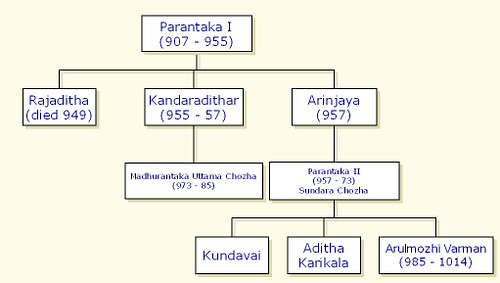
Parantaka Chozha was succeeded by his second son Kandaraditha as the first son Rajaditha had died in a battle. On the death of Kandaraditha, his son Maduranthaka was a child and hence Kandaraditha’s brother Arinjaya ascended the throne. After Arinjaya’s death, his son Parantaka II, Sundara Choza was coronated. He had two sons, Aditha Karikalan and Arulmozhi Varman and a daughter Kundavai.
When the story starts, the emperor Sundara Chola is ill and bedridden. Aditha Karikalan is the general of the Northen Command and lived in Kanchi and Arulmozhi Varman (who would be famous later as Rajaraja Chola I) is in Sri Lanka in battle and their sister Kundavai Piratti lived in Chola royal household at Pazhayari.
The story is set in motion, when rumor starts that there is a conspiracy against Sundara Chozhar and his sons. One person who gets a glimpse of the Pandya conspirators is a warrior of the Vana clan Vallavarayan Vandiyathevan. Even though the book is titled Ponniyin Selvan, the hero of the book is Vandiyathevan, a friend of Adhitha Karikalan.
It is through Vandiyathevan that we meet most of the characters in the novel such as Arulmozhi Varman, the prince whom all the people loved and Periya Pazhavetturayar, the chancellor who married Nandini when he was sixty. During his youth Aditha Karikalan had fallen in love with Nandini, but she turned vengeful after Aditha Karikalan killed Veerapadyan (who was either Nandini’s father or brother) and vowed to destroy the Chozha dynasty. We also meet Kundavai Devi, who after hearing the news of the conspiracy sends Vandiyathevan to Sri Lanka to give a message to Arulmozhi Varman to come back immediately.
The Chozha dynasty
Besides these, there are other characters like Maduranthaka Thevar, the son of Kandaraditha and the man whom the conspirators want to crown king, and Anirudha Brahmarayar, Sundara Chozhar’s Prime Minister and the man who has eyes and ears everywere. But the most wonderful character in the book is Brahmarayar’s spy Azhwarkadiyan Nambi, a Vaishnavite, who roams around the country challenging Saivaites for debates. He collects information for the Prime Minister and is always around Vandiyathevan, rescuing him during trouble.
There are some lovely women too, like Vanathi, the Kodumbalur princess who is in love with Arulmozhi, Poonkuzhali, the boat woman who rows the future king to Lanka, Mandakini, the deaf and dumb step mother and Rakkammal, the wife of a boatman who supports the Pandya conspirators. Most memorable among these is Nandini, who has the power to make influence any man.
With the help of a boat girl, Vandiyathevan reaches Sri Lanka and meets Ponniyin Selvan and becomes his close friend. In Lanka, Ponniyin Selvan realizes that his father had spent some time in an island near Lanka and had been with a girl born deaf and dumb. He meets her and realizes from her drawing that he had two children. Who are those children and do they have the right to the throne? Later one day in Thirupurambayam forest Vandiyathevan seens Nandini and the Pandya conspirators place a small boy on a throne and take a vow in front of him. Who is this boy and what right does he have to the thone? This is the kind of suspense that is maintained throughout the novel.
While coming back from Lanka, Ponniyin Selvan is caught in a cyclone and goes missing. Rumor spreads that he is dead, but he survives and stays at Choodamani Viharam, a Buddhist monastery in Nagapattinam. Then slowly the dispersed family starts asembling. The conspirators meanwhile choose one day in which both the king and both his sons would be assasinated.
Will the conspirators succeed in killing Sundara Chozha and crowning Madhuranthaka as the king or will Ponniyin Selvan be the king? That is the summary for the story. But then it is not that simple either for all the people in the novel have long histories of interaction with each other and everything is not as black and white as it seems. There are new revelations and relations being established all the time. and even when you think you can predict what is going to happen, new surprises pop up.
Even though this is a work of fiction loosely based on historical facts, some incidents are left without a closure such as the question – who murdered Aditha Karikalan. Various people confess to doing it, but even at the end, a doubt remains.
The three strengths of Kalki are plot, characters and dialogue.There is not even one dull moment in this 1800 page book. Suspense is maintained throughout the novel and when you think you have understood his techniques, the characters themselves reveal that they are not who you think they are. Even the last book is a page turner due to the unexpected turn of events. For a novel of this size, there are many characters like spies, magicians, warriors, soothsayers and Buddhists, and since the novel is this big, we get to know each of them very well. The dialogue between the characters are very poetic which looks odd in English. I am sure would have sounded beautiful in Tamil.
There are couple of points of irritation also. The author for some reason decides to pop into the novel at some places and give some commentary which is sometimes a detail about history, or a rationalization of events. This intervention broke the flow and I felt would have been more appropriate as an appendix or a separate article. In the book, Vandiyathevan goes to Sri Lanka in a boat rowed by the boatwoman Poonkuzhali, but there is very less detail of the type of boat or how they were able to navigate the ocean. In many places such technical details are glossed over.
This was originally published in Tamil, but thanks to the translation by C.V.Karthik Narayanan, non-Tamil reading people like me can enjoy this classic work. People who can read Tamil have certified that this translation is excellent. Though this book is quite lengtly, (6 books, each of about 300 pages), it is a page turner.
This was my first Indian historic novel and it gave a good idea of the Chola dynasty in a non-boring way.
(Crossposted to : varnam)